

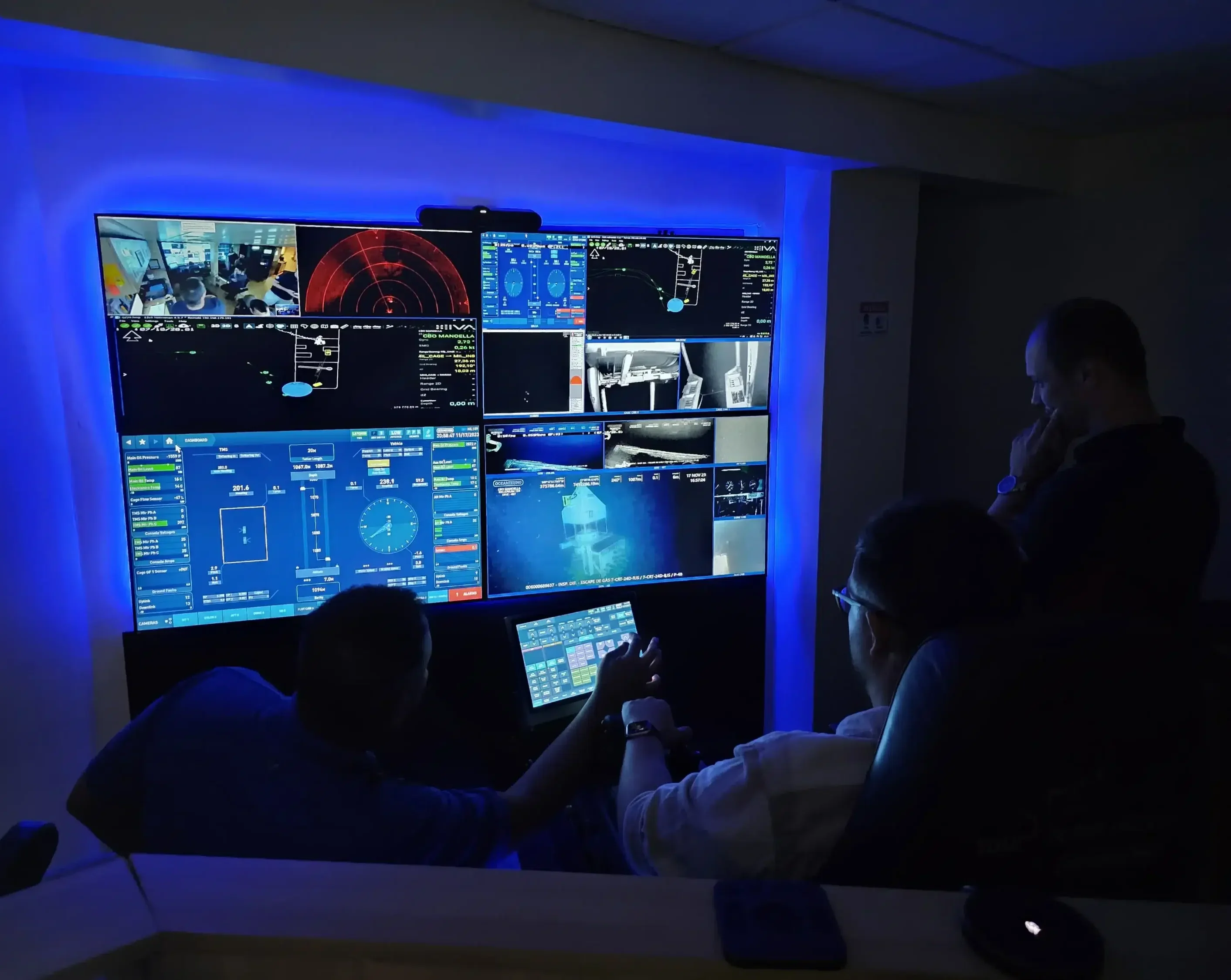
As remote operations become more common across the offshore industry, questions around safety and accountability naturally follow. One of the most frequent concerns is whether moving ROV piloting onshore reduces offshore control.
In reality, the opposite is true. Remote operations extend control.
Rather than a loss of control offshore, there’s an extension of control using a defined structure. It is procedure-driven and supported by multiple layers of connectivity and communication. From Macaé, every remote ROV piloting activity is built on a framework that ensures control is clear.
A Proven Framework for Control Handover
Our Macaé Onshore Remote Operations Center (OROC) builds on a long history of remote ROV piloting where a dual-pilot architecture drives operations and ensures continuity of control. Every handover is governed by a detailed procedure. The onshore and offshore teams ensure readiness, communication stability, and operational status. Every transfer of control is deliberate and calculated.
Three Design Safeguards That Keep Control Clear and Safe
Remote operations from Macaé are not dependent on a single system or individual. They are built around multiple layers of operational control, connectivity, communication, and cybersecurity safeguards designed to protect operational data and communications. Three of the core safeguards that help keep control clear and safe are outlined below.
1. Dual-Pilot Control Architecture
Control is never isolated to one location. The offshore pilot remains the controlling authority, while the onshore pilot mirrors the operation in real time with full visibility. This structure ensures that if conditions change or support is required, a qualified pilot is already synchronized and ready to act.
2. Procedure-Driven, Verified Handovers
Transfer of control from offshore to onshore and back again is never ad hoc. Every handover follows a defined, step-by-step procedure that confirms system status, communication stability, and pilot readiness before control is transferred. Each transition is deliberate, clearly communicated, and acknowledged by both teams to remove ambiguity.
3. Continuous System Visibility and Status Feedback
Both offshore and onshore teams operate with the same real-time data, system states, and alarms. This shared visibility ensures that decisions are based on aligned information, reducing the risk of misinterpretation during complex or changing conditions.
When Conditions Change, Control Remains
Fire alarms, weather escalation, or other unplanned events can require the offshore team to step away from direct operations with little notice. Remote ROV piloting from Macaé is designed to manage these situations without introducing uncertainty.
In these scenarios, the transition of control follows the same structured process used during planned handovers. The offshore pilot initiates the transfer when possible, confirming system status and readiness before passing control. Where immediate action is required, predefined response procedures guide how control is stabilized and transferred safely.
Because the onshore pilot is already connected, synchronized, and operating with full system visibility, they are not stepping into an unknown situation. They are assuming control with the same data, status awareness, and operational context as the offshore team.
Examples of where this capability becomes critical:
- Emergency situations, such as fire alarms, where offshore personnel must evacuate or focus on safety protocols
- Weather-driven interruptions, where offshore asset motion or conditions limit safe offshore operation
- Unplanned events, including technical issues or temporary loss of offshore resources
In each case, control is not improvised. It is transferred through a defined pathway, supported by shared visibility and established procedures. This enables operations to be paused, stabilized, or continued safely, depending on the situation, without any confusion around who is in control.
The result is not just operational flexibility. It is operational resilience, where control remains clear even when challenges arise.